

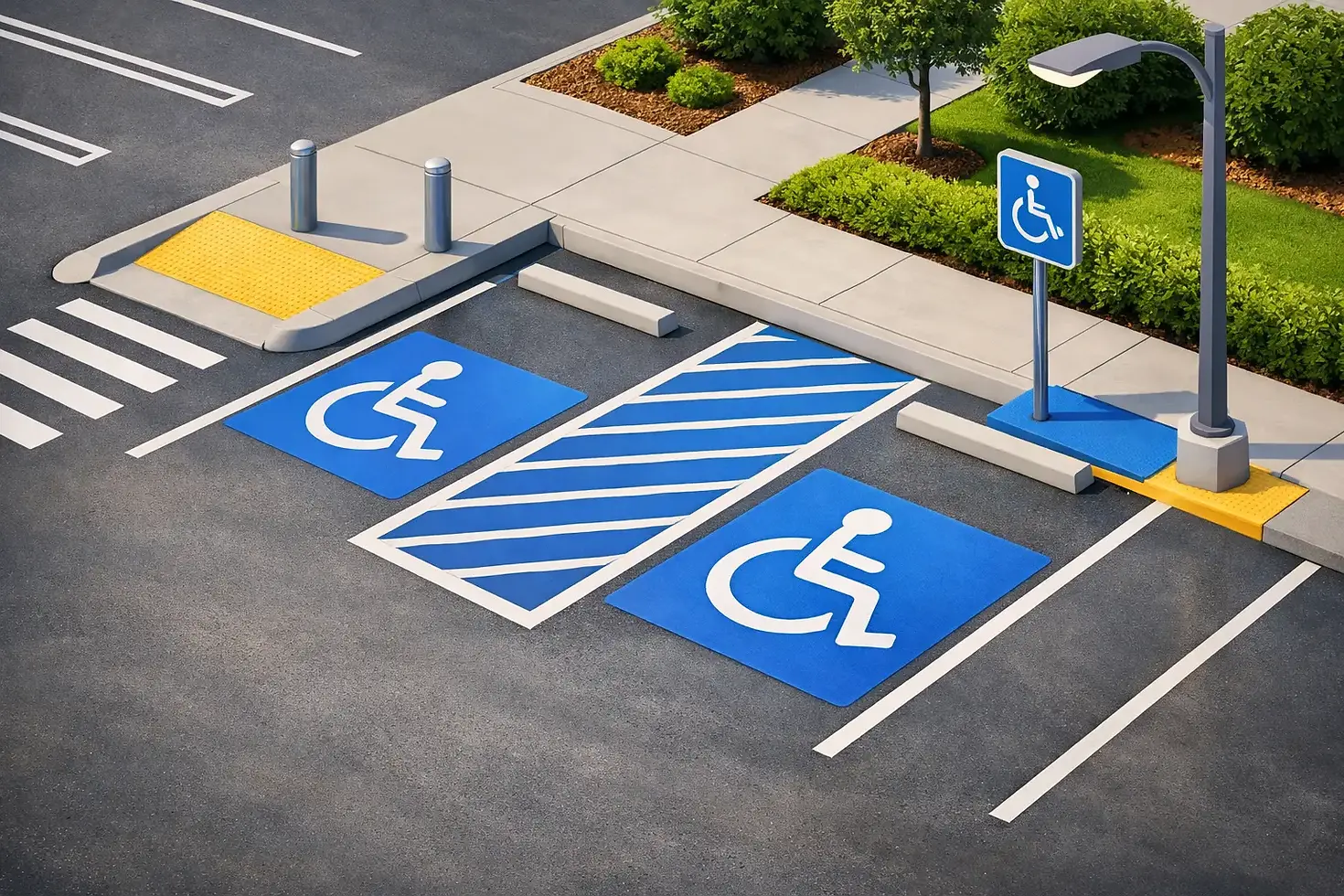
ADA Compliant Parking Lot Striping
- nettiedrown
- Jun 16
- 6 min read
A parking lot can look clean at a glance and still create real access problems the moment someone tries to use it. ADA compliant parking lot striping is not just about painting a few blue lines. It affects how customers, tenants, employees, and visitors move from their vehicle to your building safely and without added barriers.
For property owners and managers across Delmarva, this tends to come up at the worst time - after complaints, during a renovation, or when old striping has faded enough that nobody is sure what still meets the standard. The better approach is to treat accessibility as part of regular lot maintenance, just like pavement repair, drainage, and sealcoating.
What ADA compliant parking lot striping really includes
When people hear ADA striping, they often think only about accessible parking spaces. Those spaces are a major part of the job, but they are not the whole picture. A compliant layout also involves access aisles, proper placement near accessible entrances, visible markings, and the relationship between the parking area and the path of travel.
That matters because a parking lot is a system. If the stall is the right width but the access aisle is too narrow, the space may still fail the user. If the painted markings are clear but the route to the sidewalk is broken, sloped incorrectly, or blocked by curbing, the striping alone does not solve the problem.
For most commercial properties, the goal is simple. The lot should give people a clear, safe, usable way to park and reach the building. Good striping supports that goal, but the layout has to work as a whole.
Why property owners get ADA parking wrong
In many cases, the problem is not neglect. It is outdated information, piecemeal repairs, or assumptions based on how the lot looked when the property changed hands. A business owner may repaint over an old layout without checking whether the count of accessible spaces still matches the lot size. A property manager may replace faded markings but leave a noncompliant access aisle exactly where it was before.
Coastal properties also deal with extra wear. Sun, salt air, rain, sand, and traffic all shorten the life of pavement markings. In busy retail centers, condo communities, office sites, and hospitality properties, striping can lose visibility faster than many owners expect. Once markings fade, confusion follows. Drivers park where they should not, aisles lose definition, and accessible spaces become harder to identify from a distance.
There is also a practical issue. ADA rules are specific, but every site has its own constraints. Existing curb lines, drainage patterns, traffic flow, and entrance locations can make a straightforward repaint job more complicated. That is why a field review matters before anyone starts laying out lines.
Key parts of ADA compliant parking lot striping
The number of accessible spaces required depends on the total number of parking spaces in the lot. At least one of those accessible spaces generally needs to be van accessible, and larger lots may require more. That sounds simple enough, but the details are where mistakes happen.
Space width and access aisle width must be correct. The markings need to clearly define both the parking space and the adjoining access aisle so users have room to enter and exit vehicles safely. The access aisle also has to connect to an accessible route leading toward the building entrance.
Location matters too. Accessible spaces should be placed on the shortest practical accessible route to an accessible entrance. That does not always mean the absolute closest spot if the closest area creates a barrier or unsafe path. A shorter route that crosses curbs, steep grades, or traffic conflicts is not much help.
Signage is another critical part of the installation. Painted symbols on the pavement help drivers identify the space, but proper signs are typically required as well. Without them, a space may be easy to miss, especially when vehicles are parked.
ADA compliant parking lot striping and resurfacing projects
One of the best times to correct accessibility issues is during resurfacing or major parking lot improvements. When the surface is already being repaired or repaved, it makes sense to review striping, traffic layout, and designated accessible areas at the same time.
This is especially true for older lots. Over the years, many parking areas get patched, restriped, or expanded in ways that create a layout that no longer makes sense. A fresh surface gives you the chance to reset the lot properly instead of repeating the same outdated pattern.
There is a cost consideration here, of course. If the pavement is still in decent shape and only the markings are worn, restriping may be enough. If the asphalt has cracking, settlement, or drainage issues, repainting alone may not be the smart investment. Good striping on failing pavement usually does not stay looking good for long.
Common problems seen on local properties
In this region, a few issues show up again and again. One is faded accessible markings that are technically still there but no longer clear enough to guide drivers. Another is improper spacing after a lot has been restriped for maximum capacity rather than function. Squeezing in extra stalls can create problems with aisle width, traffic flow, and usable access.
Another common issue is placing accessible parking where it seems convenient for the striping crew rather than where it actually serves the building entrance best. That can happen at retail sites, churches, offices, and multifamily properties. The lot may check a box visually but still create a longer or less practical route for the person using the space.
Signage problems are also common. Missing signs, damaged signs, or signs mounted incorrectly can all create trouble. And in some cases, the striping itself may be clear, but the route from the parking lot to the sidewalk includes broken pavement or a curb transition that needs attention.
When a repaint is enough and when a redesign is better
Not every property needs a full reconfiguration. If your lot already has the proper number of accessible spaces in good locations and the issue is mainly visibility, a professional restriping job may solve it. That is often the case for lots where the original layout was sound but years of weather and traffic have taken their toll.
A redesign is worth considering when the existing layout creates recurring confusion, awkward traffic movement, or accessibility concerns that cannot be fixed with paint alone. For example, if the access aisle opens into a path that is blocked, if slopes near the space are problematic, or if the striping no longer fits the way the site is used, a fresh plan may save time and money over repeated patchwork fixes.
It depends on the property. A small office lot has different needs than a hotel, shopping center, or condo building. The best results usually come from looking at the lot in real use, not just on paper.
Choosing a contractor for ADA parking lot striping
Property owners usually want two things from this kind of work. They want the lot to be clearly marked and they want confidence that the layout has been handled correctly. That means it helps to work with a contractor who understands more than paint application.
A good contractor should be able to look at the pavement condition, existing layout, traffic patterns, and entry points before recommending the work. If adjustments are needed, they should explain them in plain terms. That is particularly important for owners who manage several priorities at once and do not want to sort through code language on their own.
For local properties, it also helps to work with a team that understands regional wear conditions and the demands of seasonal traffic. O.C. Paving works with property owners across the Delmarva area on parking lot improvements that need to look good, function well, and hold up under everyday use.
Keeping compliant striping visible over time
ADA compliant parking lot striping is not a one-time concern. Even a properly laid out lot needs maintenance. Paint fades. Asphalt ages. Repairs in one part of the lot can affect markings in another. If the site is busy, a yearly review is often a smart move.
That does not mean every lot needs full restriping every season. It means owners should pay attention before conditions become unclear. Faded symbols, barely visible aisle lines, and worn stall edges are easy to ignore when you see them every day. Visitors notice them right away.
The best time to address striping is before it becomes a complaint or a liability issue. If your parking lot markings are wearing out or the layout has not been reviewed in years, it may be time to take a closer look and make sure the lot works for everyone who uses it.



Comments